

The Diffusion of Innovations Theory explains how new ideas, products, and trends spread through a community in a predictable pattern. Introduced by sociologist Everett M. Rogers in 1962, it classifies people into five adopter categories: Innovators, Early Adopters, Early Majority, Late Majority, and Laggards.
The full story
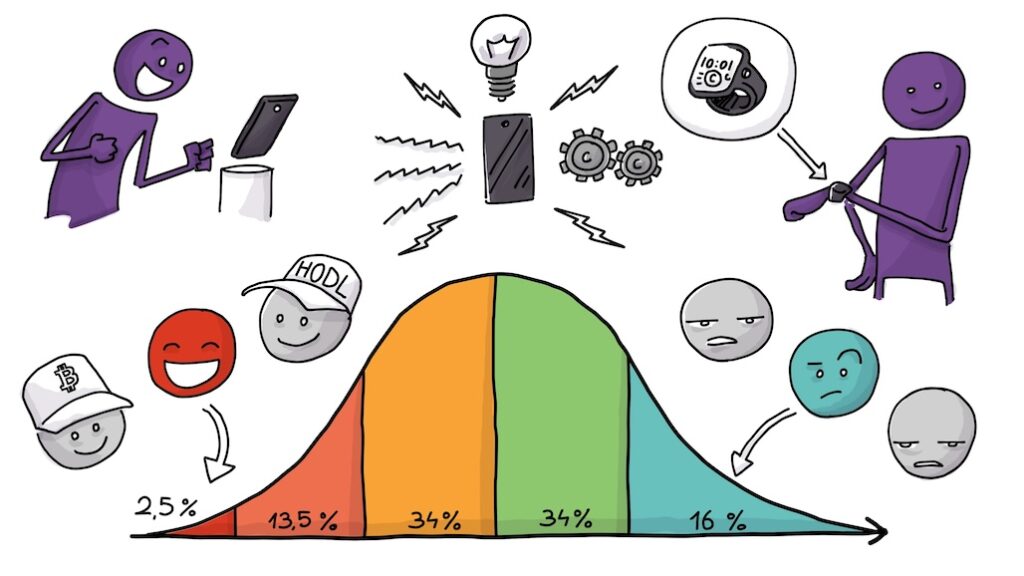
This is the pattern new trends and inventions tend to follow on their path to dominance. Understanding it allows you to join the innovators instead of the laggards. The diffusion of innovations theory explains how new products and ideas spread across five groups of people—eventually reaching all of us.
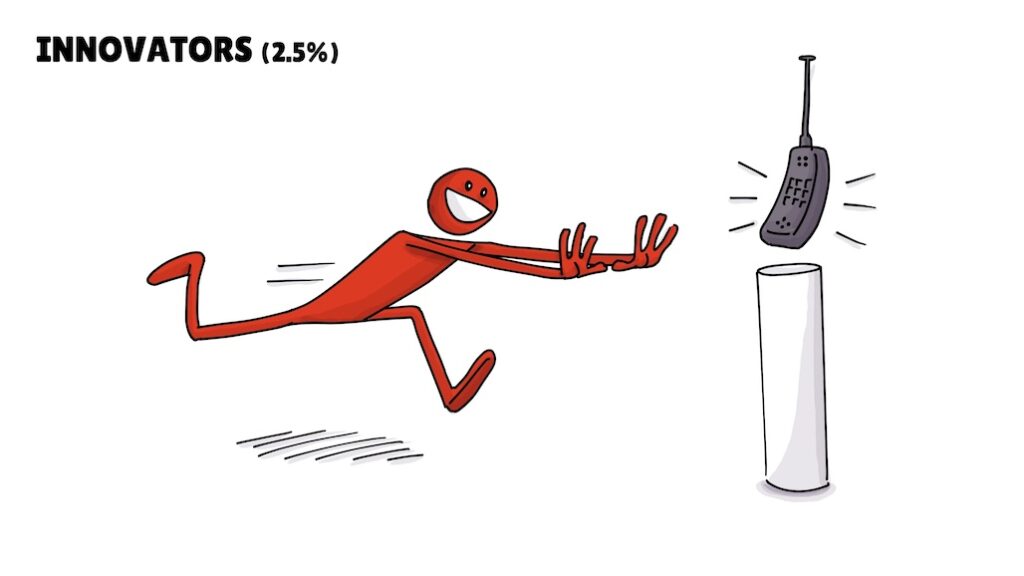
Innovators, around 2.5% of us, are the first to buy into something new. They’re curious, love trying new things, are often well off, and can take risks like spending $4,000 on a cell phone back in 1983.
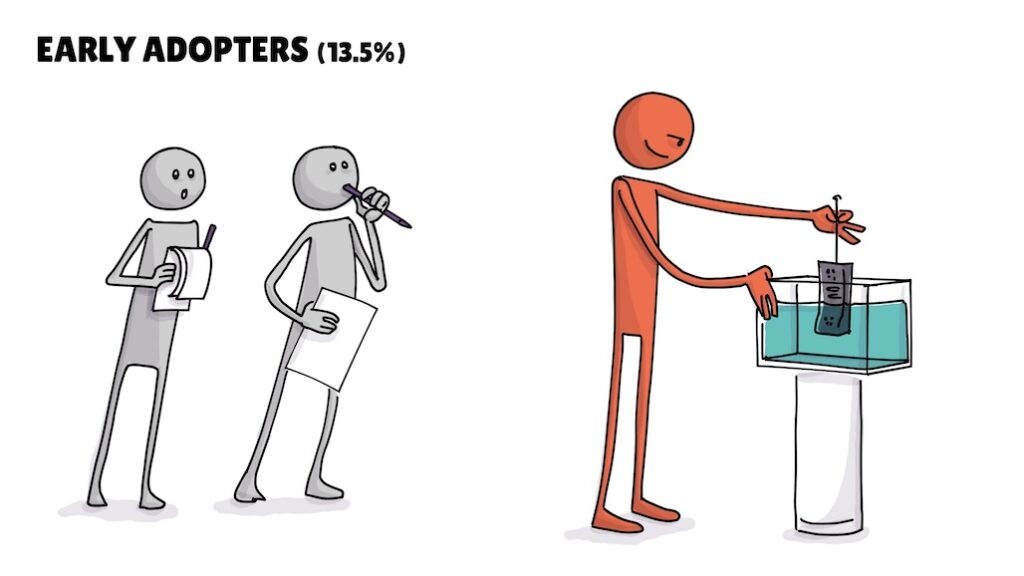
Early Adopters follow the innovators. They are respected, serve as opinion leaders, and carefully consider anything new before buying into it. Once they do, early adopters like to share their advice. Many of them got a $1,000 cell phone by 1996.
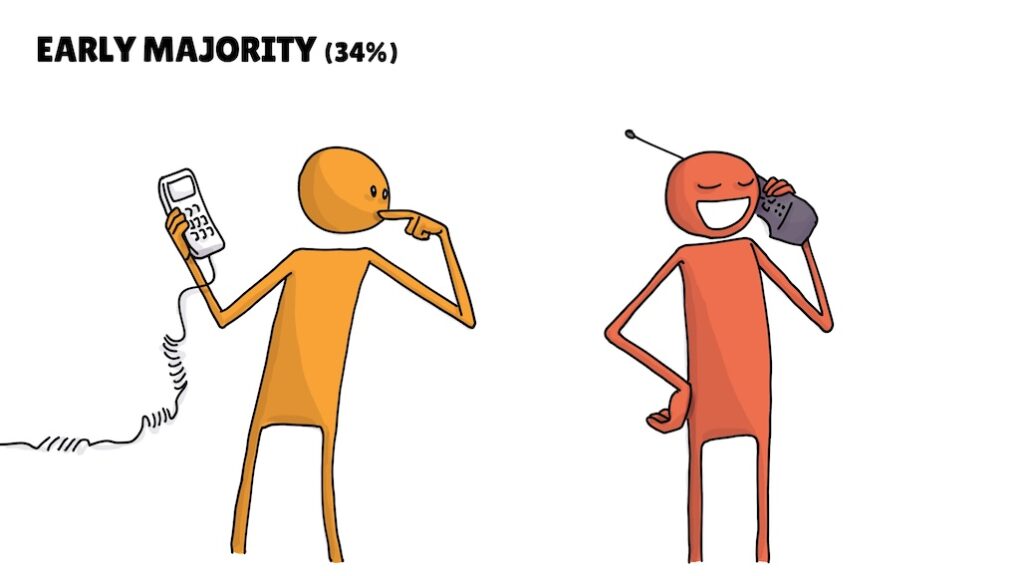
People from the Early Majority wait until early adopters have paved the way. They’re all about innovation but want to see real-world proof before making a move. Think of them as the ones who picked up $300 phones around the turn of the century.
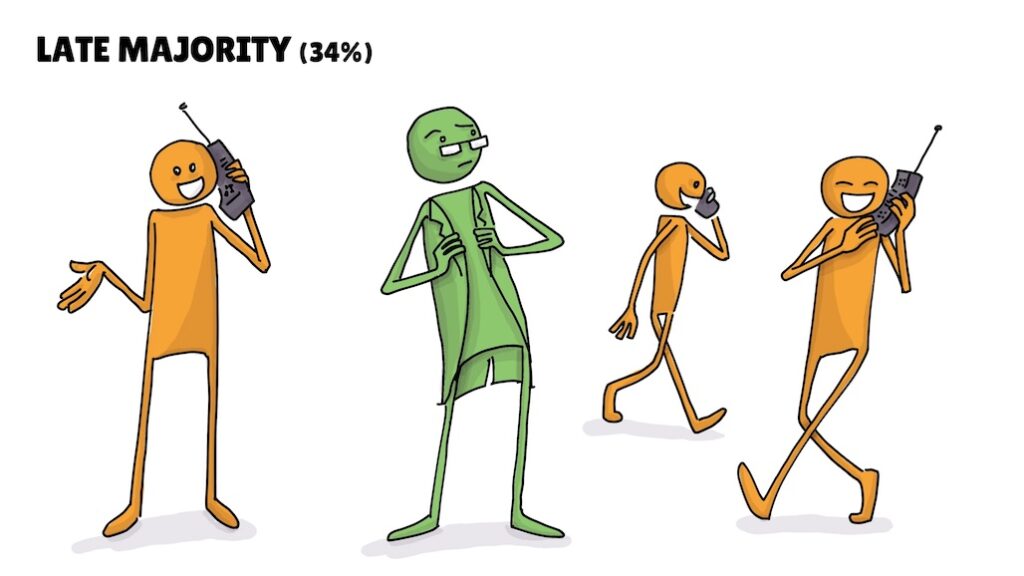
People from the Late Majority are skeptical and cautious. Often more traditional, these folks wait until a majority has embraced something before they do. They finally got a $100 cell phone in 2008, long after everyone else.
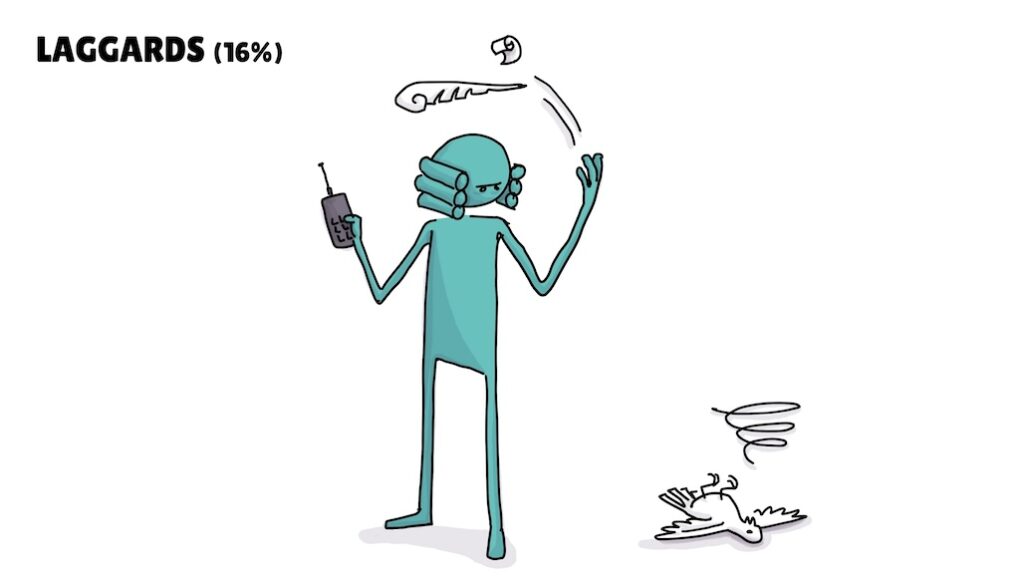
Laggards are last to pick up new trends, often due to aversion to change or lack of resources. They rely heavily on traditional methods and may adopt new things only when it’s unavoidable.
Speed of diffusion
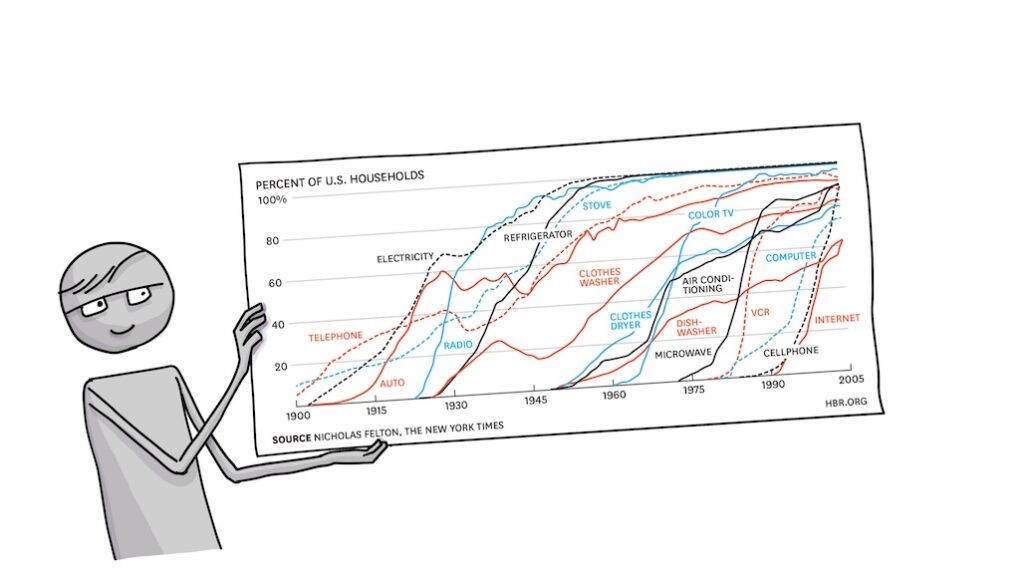
Research by Nicholas Felton suggests that as communication speeds up, innovators and early adopters can share new things faster with everyone else.
everett m. rogers’ definition
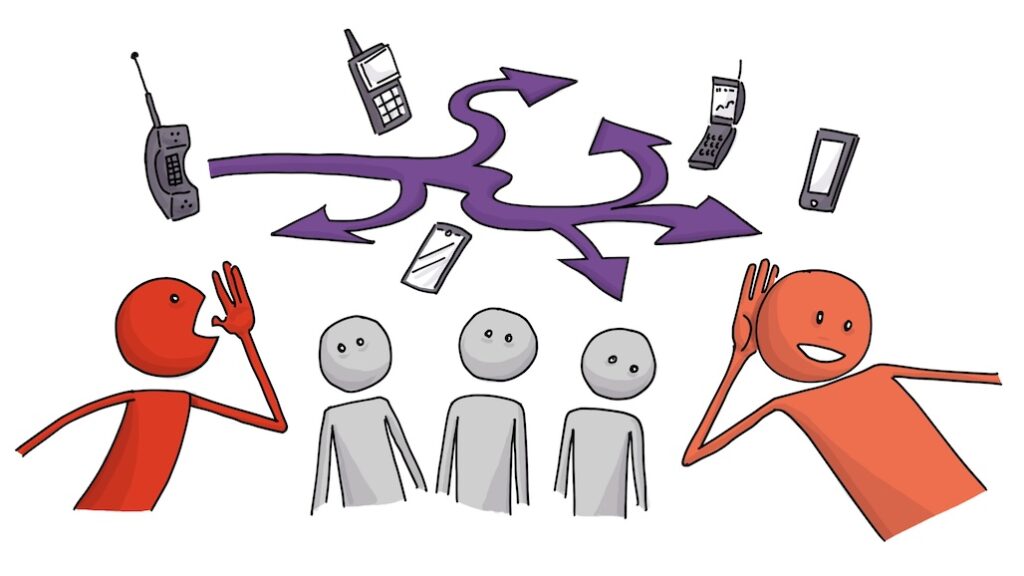
Everett M. Rogers, the sociologist who introduced the theory back in 1962, defined diffusion as: “The process by which an innovation spreads through a community over time using different channels.”
adoption factors
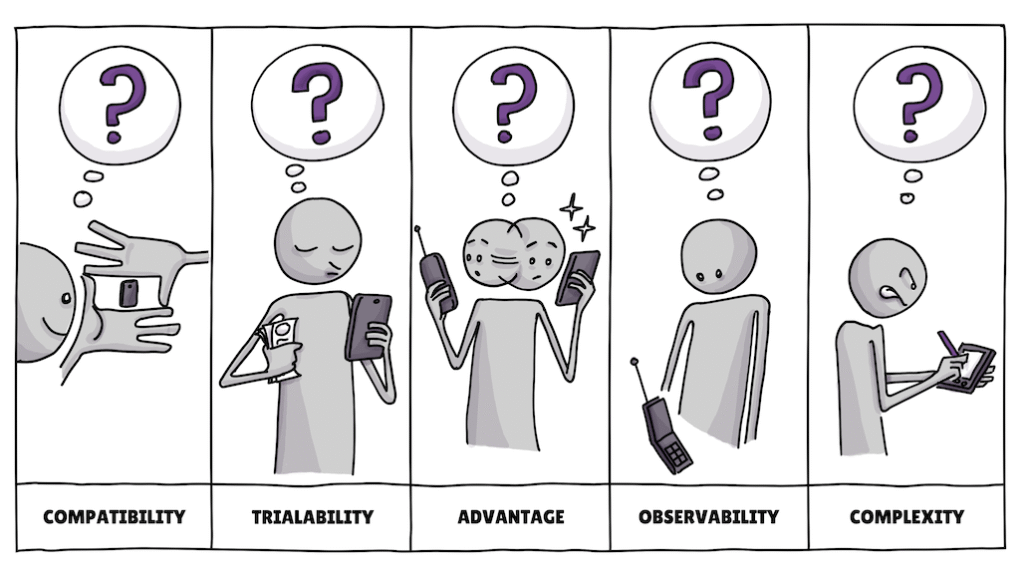
He also describes five characteristics that we evaluate when deciding whether to adopt an innovation. Does it fit with our existing values or habits? Can you try it before you buy it? Is it actually better? Can we see the benefits? And, is it easy to use? For example, an innovation might be incompatible, complex, and impossible to try out, all of which reduces its likelihood of being adopted.
But if it has a huge edge over current options innovators might be all over it, and early adopters spread the word fast.
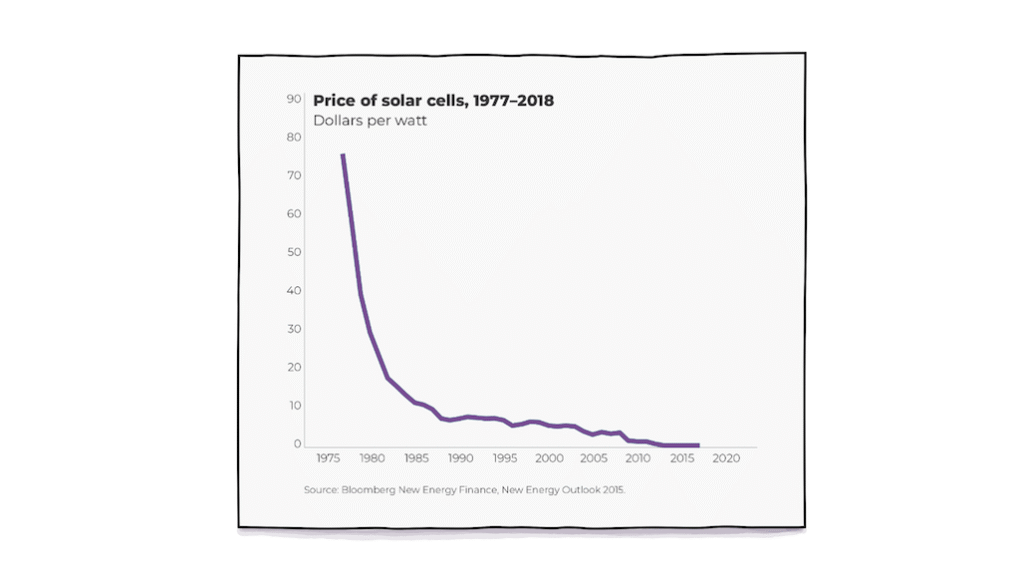
And once the price drops, which usually happens when production ramps up—see solar cells—more people jump on board. Although Rogers himself once noted: “Getting a new idea adopted, even when it has obvious advantages, is often very difficult.”
what do you think?
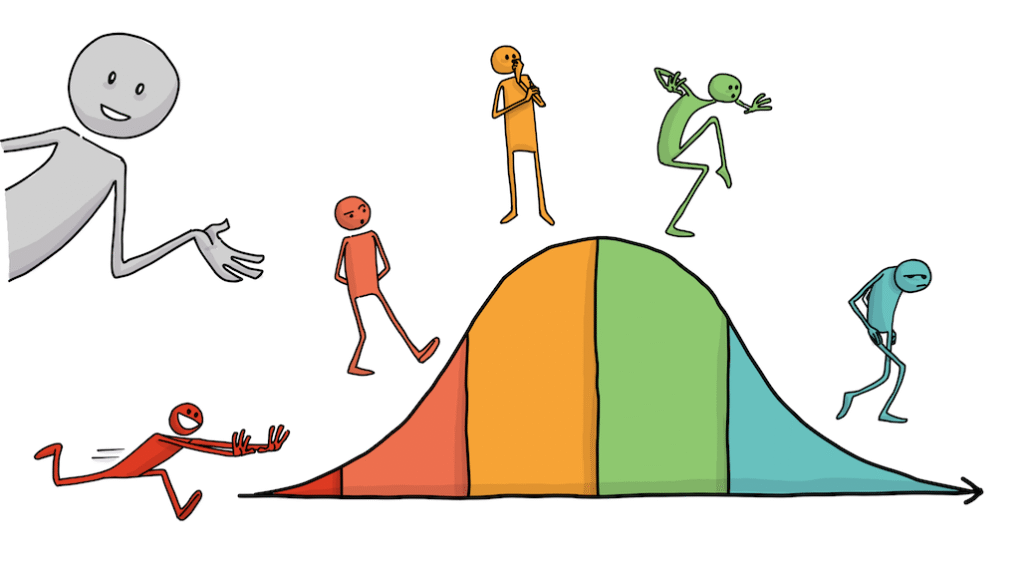
So, where do you see yourself on this spectrum? And what’s your take on this theory? Do you think it also explains how ideas, beliefs, or even social movements spread? Leave your thoughts in the comments below!
Sources
- Diffusion of innovation – Wikipedia.org
- Sorkhou, M. (2025) Diffusion of Innovation. The Decision Lab.
- Gracía-Avilés, J. A. (2020). Diffusion of Innovations. The International Encyclopedia of Media Psychology, 1-8. John Wiley & Sons.
Dig deeper!
- Read The Diffusion of Innovation: Strategies for Adoption of Products from the Interaction Design Foundation (IxDF) to better understand how this method can be integrated into marketing for new products.
- Watch 7 Tesla Innovations That Changed the Game on the Electroheads YouTube channel to see how a real-world product progresses through all five stages of diffusion.
- Explore Using Diffusion Theory as a Marketing Framework by Prof. A. Gregory Stone, published in the International Journal of Business & Management Studies, to gain deeper insight into the theory’s application in marketing.
Classroom activity
Objective:
Students will understand how new ideas and technologies spread through society by exploring the five adopter categories in the Diffusion of Innovations theory and reflecting on their own position within the adoption curve.
Materials Needed:
- Sprouts video: How New Ideas Spread
- Whiteboard or flip chart
- Markers
- Sticky notes or cards labeled: Innovators, Early Adopters, Early Majority, Late Majority, Laggards
- Student notebooks
Duration: 60 minutes
Steps:
1. Introduction and Video Viewing (10 minutes)
- The teacher asks: “Who here got the newest phone or app before everyone else? Who usually waits until it’s popular?”
- Play the Sprouts video.
- The teacher drew a table with five groups (Innovators to Laggards) on the board.
2. Group Analysis: Mapping the Curve with Real-Life Examples (20 minutes)
- Divide students into groups, ask them to draw the “innovation adoption curve” with its five segments.
- Assign each group with one modern innovation (e.g., electric cars, Tiktok, Ai tools, VR headset ) and identify how each adopter category might respond to it.
- Ask each student to evaluate himself and his group members and as a result place themselves on the curve.
3. Group Presentations and Synthesis (10 minutes)
- Group present and share their examples.
- Briefly discuss why they chose that position.
- The teacher highlights how innovation spreads over time and the role of communication speed, risk-taking, and price.
4. Discussion (15 minutes)
- Ask the students: Does this theory only apply to products – or also to ideas and social changes?
5. Reflection (5 minutes)
- Ask students to write down individually if they believe this theory is true and what other models of distribution of information they can imagine?
Collaborators
- Script: Jonas Koblin
- Cartoon artist: Pascal Gaggelli
- Producer: Selina Bador
- Voice artist: Matt Abbott
- Coloring: Nalin
- Editing: Peera Lertsukittipongsa
- Sound Design: Miguel Ojeda
- Publishing: Vijyada Songrienchai