

Social Identity Theory explains how a person’s self-concept and behavior are shaped by the social groups they belong to. In this video, we show how quickly we form a sense of belonging to a ‘tribe,’ break down the three stages of social identity, and explore what psychologist Henri Tajfel’s Minimal Group Experiments reveal about in-group bias.
the full story
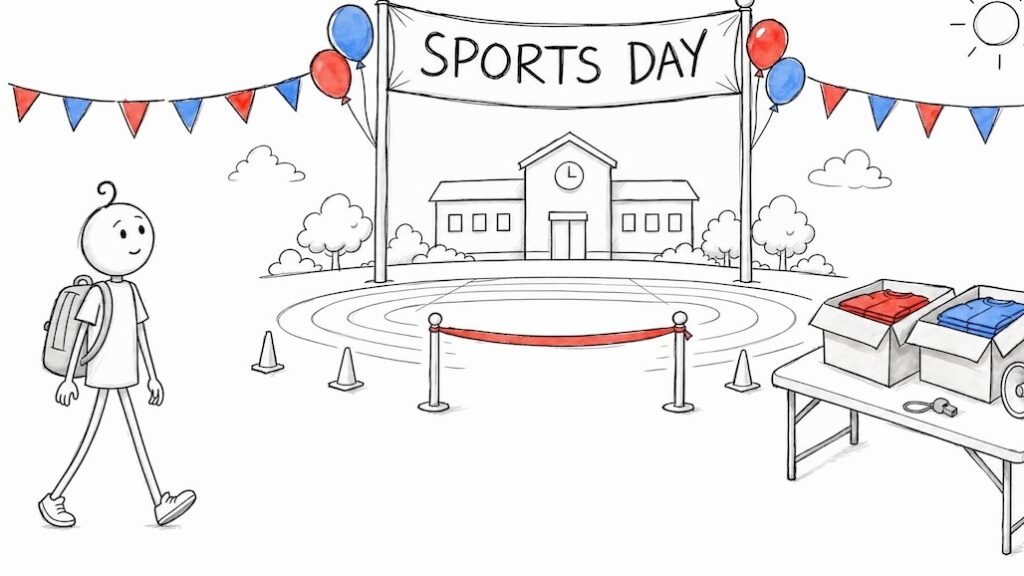
Imagine your school is having a sports day. You arrive in the morning, and a teacher hands you a red T-shirt. No explanation. No deep meaning. Just: “You are team red.” Across the field, another group gets blue T-shirts.
At first, nobody cares. You’re just standing there, slightly confused, wearing a red shirt. Then the games begin.
A red kid wins the first race, and suddenly, you’re cheering. A blue kid stumbles, and just like that, you’re laughing. By lunchtime, something strange has happened. The red team is not just “some people wearing red.” It is us. And the blue team? They are them.
Social identity theory
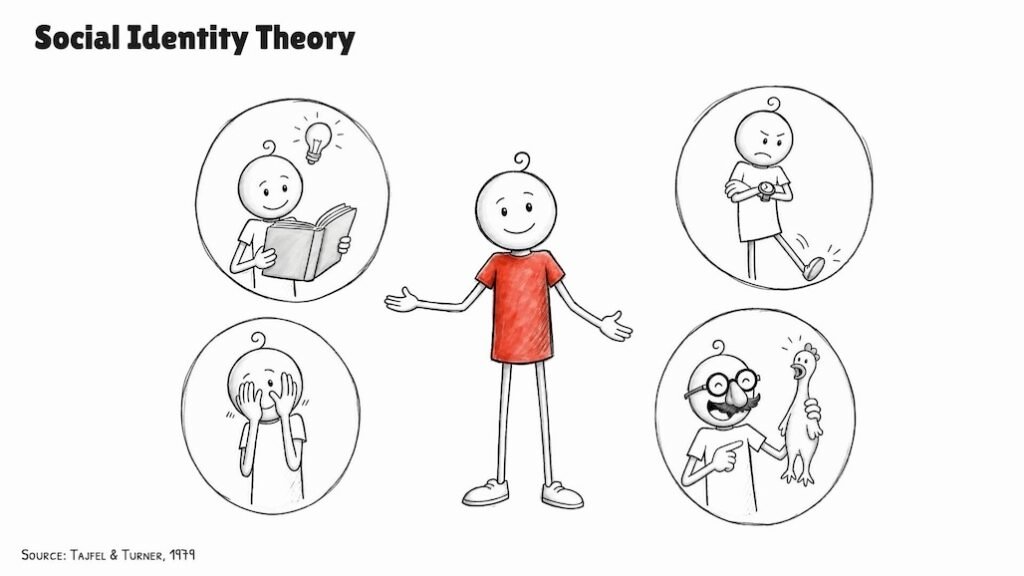
Social Identity Theory argues that we are not only individuals with personal traits, like funny, shy, smart, or impatient. But we also carry group identities. We are students of a school. Citizens of a country. Speakers of a language. Players on a team.
And when one of our groups is doing well, we often feel: “We are doing well.” And when our tribe gets insulted, we take it personally. As if someone insulted us.
3 identity stages
According to the theory, group identity usually forms in three steps.
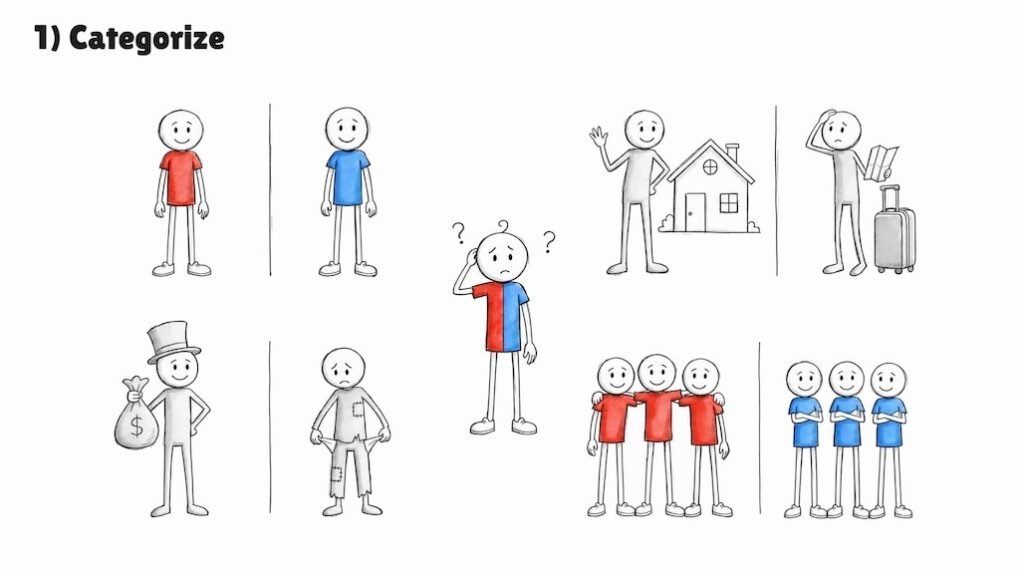
First, we categorize. We sort people into groups; Red team, Blue team. Local, Foreigner. Rich, Poor. Us, Them. This is useful, because the world is complicated, and grouping helps us understand. But it’s hardly ever that simple.
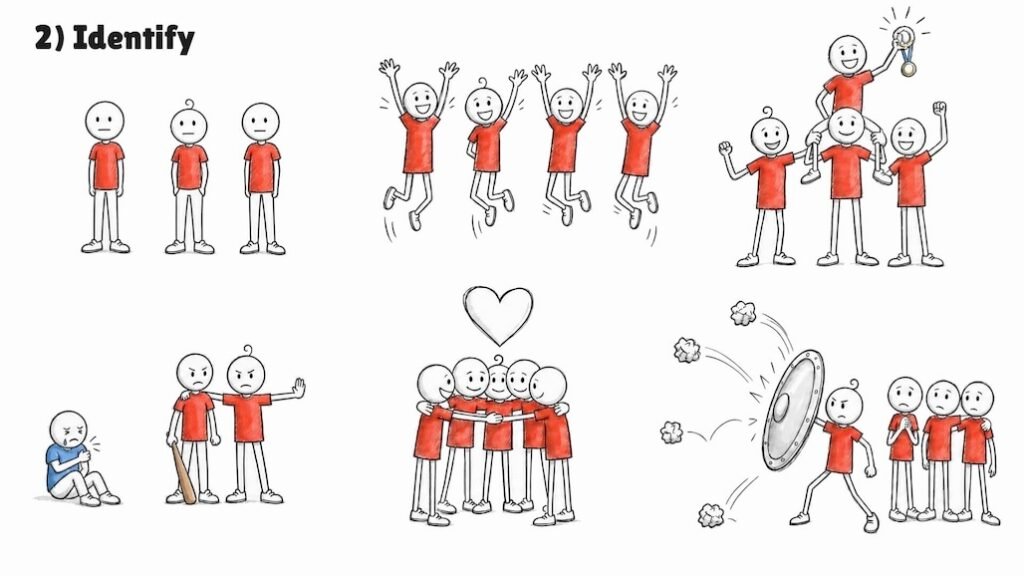
Second, we identify and start to see one group as part of us. At first, the reds are “some children with the same shirts.” After a few games, you copy the group’s mood. You celebrate its heroes. And sometimes, you even defend its bad behavior. Because when the group becomes part of your identity, protecting the group feels like protecting yourself.
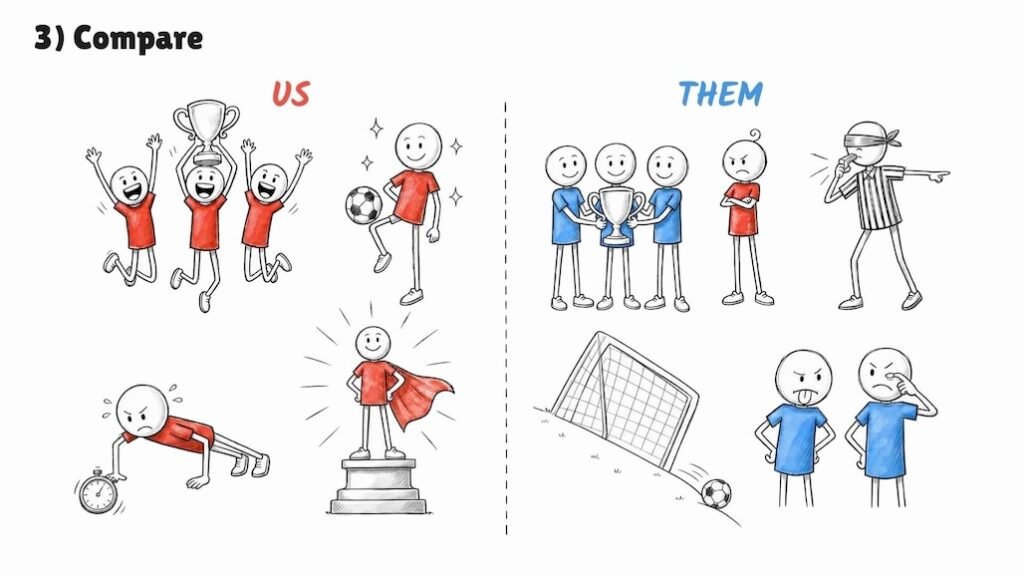
Third, we compare. Once there is an “us,” we look for a “them.” And we want our “us” to look better. So if the reds win, it’s because we are talented, disciplined, and born for greatness. If the blue team wins, it’s because the referee is blind, the game is unfair, or their players are mean.
group experiment
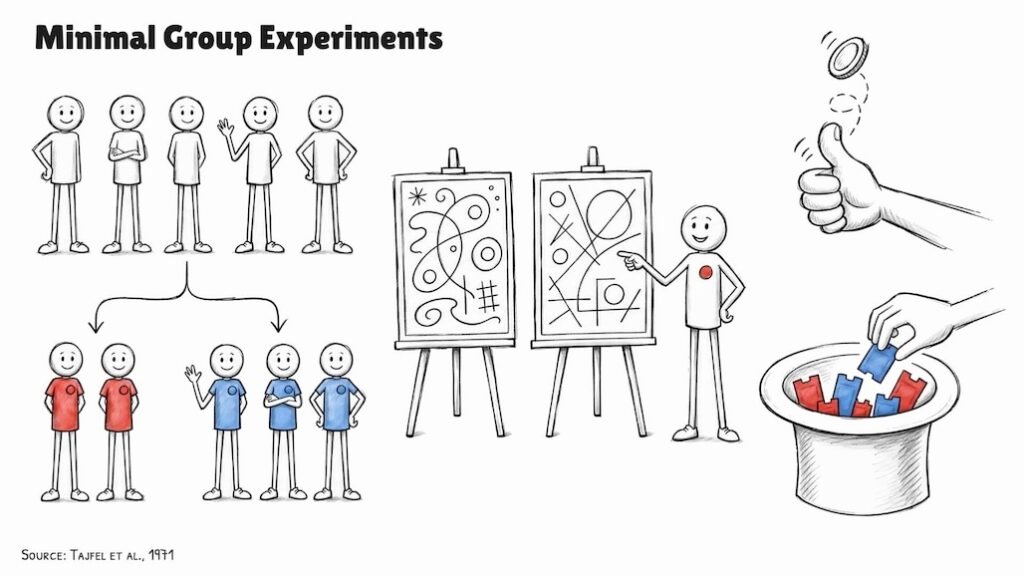
The psychologist Henri Tajfel wanted to understand how little it takes to create this “us versus them” thinking. So he ran what became known as the minimal group experiments.
Participants were divided into groups based on tiny, meaningless differences. Sometimes they were told they preferred one painting over another. Sometimes the grouping was random. The groups had no history. No competition. No ancient rivalry. And yet, when participants were asked to distribute rewards, they tended to favor members of their own group—even when they did not personally benefit or when the groups had just been invented. But why do we do this?
group self-esteem
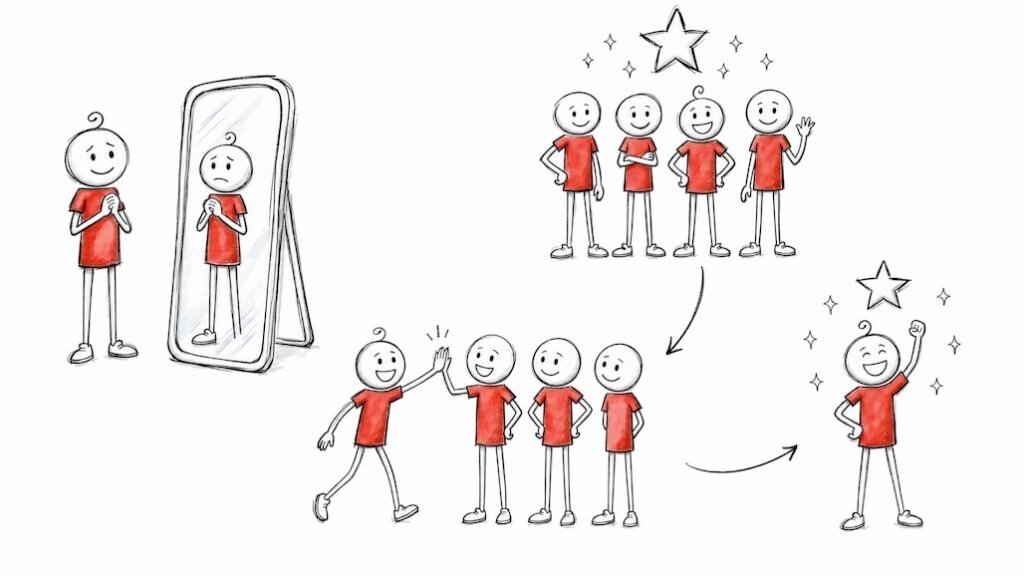
One reason is our longing for self-esteem. If my group is good, and I belong to that group, then maybe I am good too. If my team wins, I stand a little taller. If my country is praised, I feel a sense of pride. If my school beats yours, I might walk around as though I personally invented education. Our group’s status becomes part of our own.
This is why a football fan says, “We won!” Even though he watched the entire match from a sofa, eating chips and contributing mainly just crumbs.
social identity definition
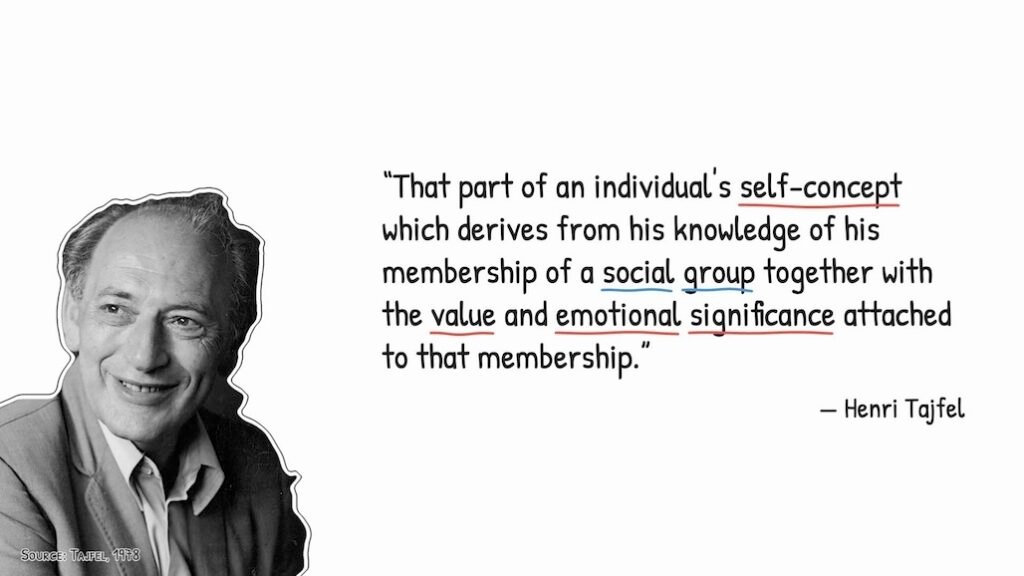
Tajfel defined social identity as “that part of an individual’s self-concept which derives from his knowledge of his membership of a social group together with the value and emotional significance attached to that membership.”
what is your tribe?
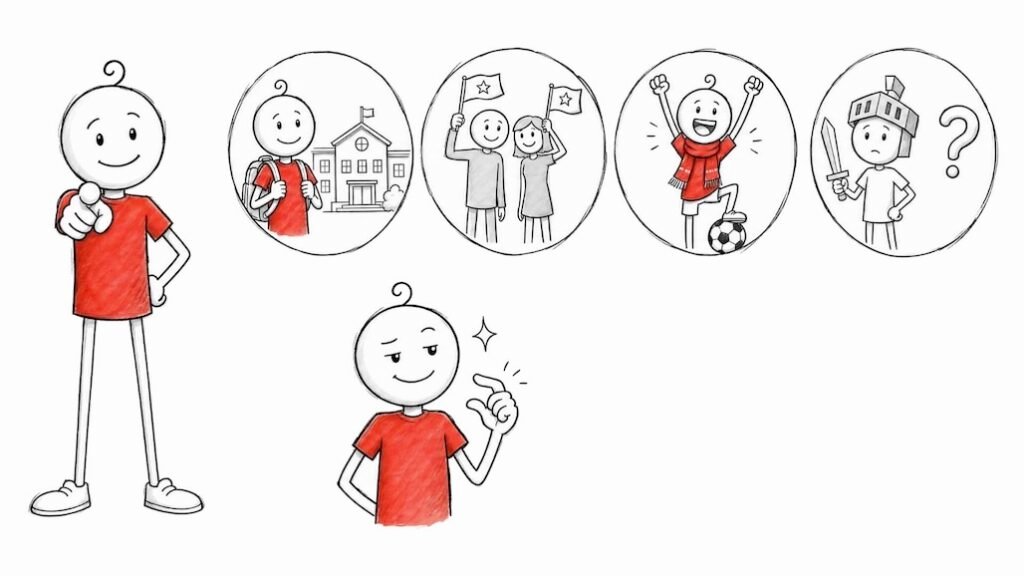
So, what’s your tribe? Your school? Your country? Your football club? Something completely different? And be honest: do you ever think your group is just a little better than the others?
Sources
- Social identity theory – Wikipedia.org
- Minimal group paradigm – Wikipedia.org
- Social identity theory – Britannica.com
- Tajfel, H., Billig, M. G., Bundy, R. P., & Flament, C. (1971). Social categorization and intergroup behaviour. European Journal of Social Psychology, 1(2), 149–178.
- Billig, M., & Tajfel, H. (1973). Social categorization and similarity in intergroup behaviour. European Journal of Social Psychology, 3(1), 27–52.
- Cialdini, R. B., Borden, R. J., Thorne, A., Walker, M. R., Freeman, S., & Sloan, L. R. (1976). Basking in reflected glory: Three (football) field studies. Journal of Personality and Social Psychology, 34(3), 366–375.
- Tajfel, H. (1978). Social categorization, social identity and social comparison. In H. Tajfel (Ed.), Differentiation between social groups: Studies in the social psychology of intergroup relations (pp. 61–76). Academic Press.
- Tajfel, H., & Turner, J. C. (1979). An integrative theory of intergroup conflict. In W. G. Austin & S. Worchel (Eds.), The social psychology of intergroup relations (pp. 33–47). Brooks/Cole.
Dig deeper!
- Explore how competition for limited prizes turned two groups of boys into bitter rivals at a summer camp in our Sprouts video on “Realistic Conflict Theory: The Psychology of War and Peace.”
- What happens when a teacher divides her class by eye color? Watch the PBS Frontline documentary “A Class Divided” to see how quickly one meaningless label changed the way children treated each other.
- Review the three steps of the theory (categorization, identification and comparison) in Simply Psychology’s easy-to-read guide to Social Identity Theory.
- Can a world map turn into a battle between groups? Read this Associated Press report on Wplace, a viral 2025 website where millions of users paint pixels onto a world map and race to defend their own cities, countries and fan communities. (Please note: the article is suitable for all ages, but the Wplace website itself may contain inappropriate content and is not recommended for students.)
- Can spending time with “them” make us less prejudiced? Learn about the contact hypothesis, which explains how contact between groups under the right conditions, such as equal status and shared goals, can reduce prejudice.
Classroom activity
Objective:
Students will experience how quickly a meaningless label creates “us” and “them,” identify the three steps of Social Identity Theory, and reflect on the groups that shape their own identity.
Duration: 60 minutes
Materials Needed:
- Sprouts video: Social Identity Theory
- Two abstract paintings: Painting with Green Center by Vasily Kandinsky and Castle and Sun by Paul Klee
- Colored stickers or name tags (two colors)
- Points sheets (one per student)
- Paper and colored pens for the Tribes Map
1. The Minimal Group Game (15 minutes)
- Show the two unknown paintings without naming the artists.
- Each student secretly writes which painting they prefer on a slip and hands it to the teacher.
- The teacher pretends to sort the slips, then hands out “Kandinsky” and “Klee” stickers, which are actually distributed randomly! (the groups are formed randomly, and not by the students preferences, but since they do not know the artists names, they won’t notice)
- Hand out the points sheet. Each student chooses one of three ways to share points between an anonymous member of their own group and an anonymous member of the other group. They can not give points to themselves.
- Option A: 10 points for my group’s member and 10 for the other group’s
- Option B: 13 for my group’s member and 13 for the other group’s
- Option C: 9 for my group’s member and 5 for the other group’s
2. Results and Video Viewing (15 minutes)
- Count the answers together on the board.
- Ask: “Option B gave the most points to everyone. Why did some people choose A or C?”
- Reveal that the groups were formed entirely randomly, and that you actually didn’t use the students’ slips about their preferences.
- Then watch the Sprouts video on Social Identity Theory.
- Explain that Tajfel found the same pattern: Many people gave up points so their group would come out ahead, so “us” could beat “them.”
3. Three Steps in Action (10 minutes)
- In pairs, students link each step of the theory to what happened in class:
- Categorization: we were sorted by painting.
- Identification: we wore the sticker and felt like “Klee people.”
- Comparison: we wanted our group to come out ahead.
- Invite a few pairs to share their answers.
4. My Tribes Map (15 minutes)
- Each student draws themselves in the middle of a page and adds a circle for every group they belong to: school, team, family, language, hobby, online community.
- Next to each circle, they rate how strongly they identify with that group, from 1 to 5.
- In pairs, students find one tribe they share and one they don’t. Then they discuss the video’s question: “Do you ever think your group is just a little better than the others?”
5. Reflection and Sharing (5 minutes)
- Mix the class back together and remove the stickers.
- Students complete this sentence: “One group I belong to is ___. A time I felt ‘we are better than them’ was ___.”
Teacher Note: Keep the game light. Never group students by real characteristics such as appearance, background or ability. At the end, make it clear that the groups meant nothing.
Collaborators
- Script: Jonas Koblin
- Voice: Matt Abbott
- Production: Selina Bador
- Publishing: Vijyada Songrienchai

